

Widely considered one of the most effective water filtration methods, reverse osmosis (RO) creates clean, great-tasting water. RO systems are used in a variety of applications, including filtration for whole healthcare sites. No matter what kind of water you start out with, there is likely an RO system that will suit your needs. Below you will find what reverse osmosis systems are, how they are beneficial, and what they are used for.
Reverse osmosis is a multi-stage water treatment process that removes contaminants from unfiltered water or feeds water when pressure forces it through a semipermeable membrane.
Health site reverse osmosis systems utilise at least three stages of treatment to reduce levels of virtually all contaminant types.
In the final stage, the RO membrane, water flows from the more concentrated side (more contaminants) of the membrane to the less concentrated side (fewer contaminants) to provide clean drinking water. The freshwater produced is called the permeate. The concentrated water left over is called the waste or brine. The DDL3 reverse osmosis system reprocesses the waste/brine to reduce the wastewater going down the drain…
Reverse osmosis utilises a semipermeable membrane with very small pores that trap contaminants while water is pushed through. In osmosis, water becomes more concentrated as it passes through the membrane to obtain equilibrium on both sides. Reverse osmosis, however, blocks contaminants from entering the less concentrated side of the membrane. For example, when pressure is applied to a volume of saltwater during reverse osmosis, the salt is left behind, and only clean water flows through.
A reverse osmosis system removes sediment and chlorine from water with a prefilter before forcing it through a semipermeable membrane to remove dissolved solids. After water exits the RO membrane, it passes through a postfilter (a de ioniser used in a benchtop autoclave) to polish the drinking water before entering a dedicated faucet. Reverse osmosis systems have various stages depending on the number of prefilters and postfilters.
The RO membrane is the focal point of a reverse osmosis system, but an RO system also includes other types of filtration. RO systems are made up of 3, 4, or 5 stages of filtration. Every reverse osmosis water system contains a sediment filter, a carbon filter (sometimes 2), and the RO membrane. The filters are called postfilters and prefilters, depending on whether water passes through them before or after it passes through the membrane. Each type of system contains one or more of the following filters:
THE DDL3 DOES NOT REQUIRE A TANK SO FREEING UP SPACE AND LIMITING INFECTIONS.
An RO tank is used with the entry-level DDL1 and DDL2 systems, and it holds reverse osmosis water, so you have plenty to use when needed. A reverse osmosis system outputs water slowly. It takes one minute to produce two to three ounces of RO water. If you were to turn on your faucet for a glass of water at the actual membrane production rate, then you would have to wait at least 5 minutes for it to fill. With a storage tank, your DUWLs and autoclave refill jug fill instantly. The tank’s bladder requires pumping up to 10 psi at each service interval. A tank typically has a lifespan of five years.
Reverse osmosis removes chlorine, salt, PFAS, and dissolved solids like arsenic and fluoride through the RO membrane. RO systems also include sediment and carbon filtration for a broad reduction spectrum. The carbon filters in an RO system remove chlorine, bad taste, and foul odours; the sediment filter removes dirt and debris.
Reverse osmosis removes:
The contaminants listed are some of the most popular ones treated with an RO system, but the system also removes many other contaminants.
Reverse osmosis systems do not remove some bacteria and viruses. If your water comes from a city treatment plant, it should already be microbiologically safe. Reverse osmosis may remove some bacteria, but bacteria could grow on the membrane and potentially enter your water supply.
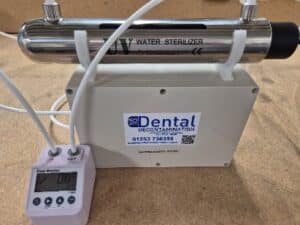
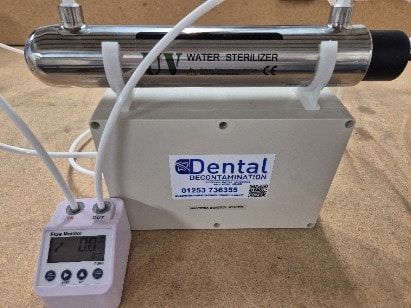
To remove living organisms and viruses, we recommend the DDL UV sterilisation system.
Pretreatment can greatly extend the life of a reverse osmosis membrane when water quality is poor. When certain minerals, bacteria, chemicals, or other substances contaminate water as it flows through an RO membrane, they can absorb or form deposits on the membrane. The buildup of contaminants in an RO membrane is known as membrane fouling, and the forming of inorganic deposits is known as membrane scaling. To prevent membrane fouling and scaling, you must remove the contaminants before they can harm your RO membrane.
Different contaminants require different pretreatment solutions, so you must know the makeup of your water before deciding on an appropriate pretreatment system. Well water, for example, will need more thorough prefiltration than city-treated water.
Biofouling is the result of the buildup of biological contamination on a reverse osmosis membrane. City-treated water should be free of microbiological contaminants unless a boil water advisory is issued, so healthcare site managers with well water should be the ones most concerned with biofouling. To get rid of biofouling, you must get rid of the microorganisms that make their way to the membrane.
The most practical method for biofouling prevention for reverse osmosis is ultraviolet disinfection. See DDL U.V. system
The DDL U.V sterilisation system deactivates microorganisms with UV light (LED), preventing bacteria, viruses, parasites, and other microorganisms from reproducing. When using a UV disinfection system, ensure that you install a sediment filter before the UV system. If not paired with a sediment filter, dirt, debris, and sediment particles can hinder the effectiveness of the UV system. If your setting uses well water, incorporating a UV system into your setting well water system is essential in keeping you and your patients and colleagues safe from waterborne illness.
Reverse osmosis membrane scaling can be resolved by a few pretreatment solutions. Two common residential pretreatment solutions for dealing with membrane scaling are water softeners and scale inhibitors.
Water Softeners exchange sodium or potassium ions from a brine with calcium and magnesium ions in hard water. Because of how they operate, water softeners are commonly called ion exchange systems. Hard water can be treated by a reverse osmosis membrane, but it will greatly shorten its lifespan. As a result, water softening is the most efficient way to receive high-quality soft water from a reverse osmosis system while elongating the lifespan of the membrane.
Water softeners are also a practical method for preventing scale buildup in residential RO systems.
See DDL TAC systems. Scale inhibitors are chemicals /crystals that are added to feed water delivered to an RO system. These chemicals/crystals increase the amount of inorganic compounds that water can dissolve, allowing the system to operate at a higher production rate.
Scale inhibitors are excellent for dealing with the two most common inorganic salts in water, calcium carbonate and calcium sulphate. They are also effective across a wide pH range, safe to handle and use.
Feed water should contain low levels of iron, a common well water contaminant, when using a scale inhibitor to prevent iron from reducing the efficacy of the inhibitor.
Reverse osmosis booster pumps are essential if your home’s water pressure is below 40 psi. If your water pressure is between 40 and 50 psi and your water’s TDS levels are over 500 ppm, you should also use a booster pump.
If you do not use an RO booster pump and you have low water pressure, your RO system will not produce water as efficiently or effectively as it can. Homes that use city-treated water rarely need an RO booster pump, but homes with well water are more likely to experience low water pressure that necessitates a booster pump.
A reverse osmosis system is one of the most extensive methods of filtration. It removes 98% of dissolved solids, which makes it healthier to drink. A water distiller is the only other drinking water system that also reduces TDS, but it’s less efficient than an RO system.

01253 736355
Opening hours
Mon – Thurs: 09:00 – 16:30
Fri: 09:00 – 16:00
Feel free to call outside of these hours and leave a message.
Alternatively, fill in a short form