
In a UK dental practice, the requirements for potable water are stringent and primarily guided by Health Technical Memorandum 01-05 (HTM 01-05): Decontamination in primary care dental practices, along with other relevant health and safety legislation like the Health and Safety at Work etc Act 1974 and Approved Code of Practice (ACOP) L8 for the control of Legionella bacteria.
This is the most critical area for water quality in a dental practice. While mains potable water can be used to supply DUWLs, it is strongly recommended and widely practiced to use reverse osmosis (RO) water or distilled water in self-contained dental chair systems.
HTM 01-05 states that the water used in DUWLs must comply with drinking water standards, with a bacterial level not exceeding 100-200 Colony Forming Units (CFU)/ml of aerobic heterotrophs at 22°C.
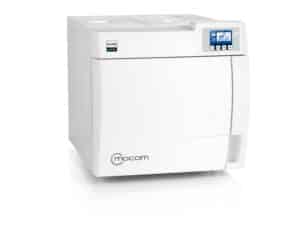
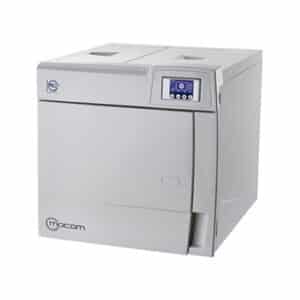
HTM 01-05 states that autoclaves should be filled, at least daily, using distilled or RO water. This is essential to prevent scale build-up and ensure effective sterilisation of instruments.
Instruments cleaned in an ultrasonic cleaner or by hand should be rinsed thoroughly in a dedicated sink or bowl using satisfactory potable water, or freshly prepared RO water or distilled water to remove residual soil and detergents.
Key takeaway for UK dental practices:
While mains potable water is used for general facilities, specialised dental equipment like DUWLs and autoclaves require purified water (preferably RO or distilled) to meet infection control standards and minimise the risk of patient and staff exposure to waterborne pathogens. Strict adherence to HTM 01-05 and regular risk assessments and maintenance are paramount.
May we establish what consumables are involved in a reverse osmosis system:
The reverse osmosis system will convert the city water down to between 3 and 25 ppm tds depending on the location and the quality of the city water. That r.o water is then “polished” in a de ioniser pod to reduce the tds right down to ZERO.
Over many years Dental Decontamination Limited have studied compliant potable water introducing many innovative equipment and sanitisation protocols.
We have discovered that every site has to be analysed on an individual basis.
Many things have to be considered whilst working towards producing suitable potable water:
Once the above information is collected we can analyse it and then make recommendations on what system should be introduced.
We will also introduce systems and technology to minimise the service intervals but maintain the low ppm tds.
We recommend that in hard water areas a DDL TAC system is fitted to reduce the scale in the incoming city water.
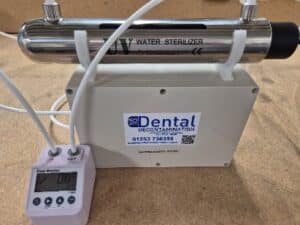
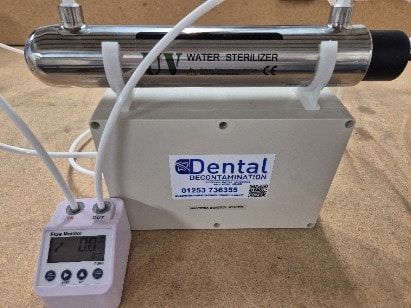
A DDL WS1 will ensure the practice has no or very few failed dip slides that are taken from the reverse osmosis tap.
When we conducted our tests of tanked systems we discovered that because the protective chlorine had been removed from the city water they were susceptible to infections.
The common denominator?… the r.o water has no protection …protection city water possesses.
We initially used 3% Hydrogen Peroxide to sanitise the systems internal surfaces which took place during the service protocol. Method statement available.
The results were encouraging and were documented. Every time we carry out a service of a reverse osmosis system we sanitise all the surfaces with 3% H202. With 3% H202 not being a chemical it breaks down into H and O molecules POST ACTION.
Nigel Bannister
Dental Decontamination Limited
www.DentalDecontamination.co.uk
June 2025