
The lifespan of a resin cartridge (specifically, the DI resin) connected to a Reverse Osmosis (RO) system can vary significantly, but here’s a general breakdown and the key factors that influence it:
The RO membrane is the primary filter in the system, removing the vast majority of TDS. If your RO membrane is aging or not performing optimally (i.e., its “rejection rate” is dropping), it will allow more impurities to pass through to the DI resin, causing it to wear out faster.
Regularly flushing and maintaining your RO membrane can prolong its life and, in turn, the DI resin’s life. The DDL3 unit has an integral flushing system.
These filters protect the RO membrane and, indirectly, the DI resin. If the sediment and carbon filters are not changed regularly (typically every 6-12 months), they can allow larger particles, chlorine, and chloramines to reach and damage the RO membrane and subsequently exhaust the DI resin faster.
Infections e.g pseudonyms can effect the tds as biofilms present in the system push the tds up.
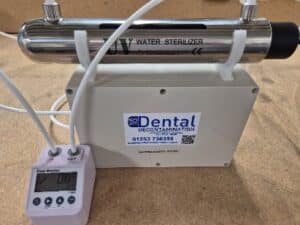
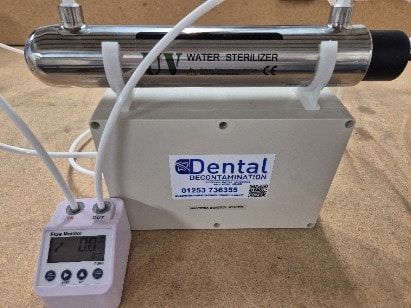
Dental decontamination have introduced the DDLWS1 using U.V. technology which sterilises the reverse osmosis water produced by the system.
Generally speaking, each DIRM cartridge can take out up to 24,000 TDS (or mg/l of mineral content). To keep it simple you could just say a set of 2 DIRM filters in a standard DIRM unit (consisting of two DIRM cartridges) can remove up to 48,000 TDS from the water, divide that by the incoming TDS and you have an approximate litres capacity.
So if we used the example of the RO water being at 5 TDS, it would be 48,000 / 5 TDS = 9600 litres capacity.
Dental Decontamination offer the DDL digital flow meter to check on the r.o water usage.
*only a rough guide as many other possible variables, the type of mineral content affects it if the water was more skewed towards cation or anion
minerals (the DIRM cartridge contains a blend of media to target both types but one type could deplete before the other in extreme scenarios) and things like TDS creep in the membrane will be a higher tds after a period of non use, also flushing the filters after a filter change before reconnecting the unit to the DIRM housing is important as the TDS is much higher while flushing the filters which would eat into the DIRM filter life.